Edges don't resolve into points: a letter to my friends
A note before you start. This began as a letter, printed and posted to friends in July 2026 alongside a copy of the introduction to Clarissa Pinkola Estés' Women Who Run With the Wolves. It's where philosophy meets technology for me: somatic healing, folklore and gardening run into voltage thresholds, compilers and the Manchester Baby, all circling one question: where do edges come from, and what does it cost to hold them? It's also how Slower Networks began: a small, invite-only network for sending letters, zines and drawings to each other through the post.
To my friends,
Last year, in place of a Christmas card, a friend sent me a Russian short story in the post. Having something in my hands that had been in his hands, having in some small way impacted his very being, made reading the story feel all the more charged. It's a simple thing, lending a friend a book. But a friend going out of their way to post you something that moved them felt like an act of transmission. So, stealing this idea, I wanted to share with you all a text that had a huge impact on me last summer, fondly known to those whose orbits crossed mine around that time as "crash out summer". It seemed to be the hottest summer in memory - until this one, of course, and probably every one that will follow it - and that sweltering heat produced a season of fresh, carnal, scorching vivacity.
Crash out summer began through a series of texts recommended by friends. First - What It Takes to Heal by Prentis Hemphill. A somatic therapist and Black activist, Hemphill locates the body as the site of revolutionary care, and transmutes the idea that the personal is political so that it cuts both ways at once. It's not that the personal is political, or the political is personal, it's that by virtue of their interpenetration - healing, on and through the body, becomes political work in itself. Neither self-care depoliticised into consumption nor organising cultures that treat attention to the inner life as indulgence will do. Our bodies are inscribed with stories bigger than us, that transcend the language we use to describe them. But within that book I found a tension - it's trying to tell you something that can't be understood through words. The path to freedom, if there is one to be found, is embodied, and no one else can tell you how it feels to confront it. The sign is always reduced to an echo - there is something here, if you look, but you must first look yourself, and look around and outside of these words.
Around the same time, I finished a spring fiction frenzy with the book Kingfisher, written by an old friend from school. The book is about relationships, love and lust, and the small weather running between them. But it was the articulation of nature, of rivers and birds, that captured me. It's a book where the characters are in and of the world, where an untamed wild spirit hums somewhere you can't quite place. I'd spent two years digging a garden, and gently corralling chaos down the entropy gradient (I became slightly obsessed with the dance between order - high biodiversity, the productive capacity of the garden - and chaos - the tendency of nature towards other unaligned goals - but that is a story for another zine…). This is always process and never state; it takes stewardship and intention. I felt that Kingfisher captured the immanent snagging of feelings in the body, pre-verbal, and only drawn near the surface of consciousness once given the quiet space of being out open in nature. A gentle breeze across your face - you feel the truth of it - "the wind that blows soul into the faces of listeners" (as Estés has it, in the very text I'm sending you). The still moments where the conscious mind quiets and the bubbling subconscious flitters things in and out of existence, the tension between the two parts dissolving ever so slightly in the static. So inspired was I by that prose that I started writing myself. It was an amusement even to me that what came out was an erotic memoir.
The process of writing then became devastating. Prising cataclysmic truths loose the more words I set down on the page. Their jagged edges pointing up through the life I'd constructed around them. I began finding myself at odd hours, reflected through language, in ways I hadn't anticipated. Catching glimpses of myself in a mirror world of symbols. Memories chafing against each other each time I visited them. I stepped back to view a moment one way, then again another, through a thousand different angles - a process of meaning-making that looped back round the very moments that led to me once, there in the memory, and then again, to my own organising of them on the page (and again now, here).
Having been long labelled "intellectual", and spending great chunks of my life in the pursuit of knowledge, and most recently to the shame of having had power so effectively castrate me into the role of productive labourer concerned with the advancement of a career in rational and logical thinking, I began to have a gnawing sense that my conscious mind had been treating my body as merely a vehicle of flesh and bone to lug my brain around. That this familiar friend - me, these fleeting moments of cohesion I summon into being when I reflect, and again when I write - that this thing had something stranger lurking, inaccessible through language, something carnal. A sensuous, meat-and-blood animal. The more I stuck my hands in soil, and retired inside to my desk to let muddy fingers spill words out in the solitude of the countryside, I struck something in the substratum - the bones of a wild animal. Disinterred, it took form, its feral impulses refusing the neat box of my life.
Around this same time I went to get a massage and the masseuse told me that my energy felt like the sea. Steady, yet in motion. Flowing, in and out. It was during the course of this massage that something in me gave way in a place words don't reach. They reconstruct abstractions, emotions, ideas, in messy ways, through lossy channels, from one mind (or many) to another (or many). But the settling of some truths can only take place in the body. Immanence has long been a philosophical knot that I've snagged on during my knowledge quest across domains. Moments where the structures of inside and outside dissolve into one another - life's edges - it verges on the numinous. I enjoy describing myself as a hedonist, in the sense that I search for the moments where thought collapses into immanence and boundaries blur - something I've come to call "ridge work".
Some sites of ridge work that I've found: a cute outfit (colour, pattern and texture), a live gig (music and art generally), sports (the body and mind in concert), all the senses, food so good I cry, smelling flowers, touch, pleasure, drugs, sex. God damn sex. Which is not built from lack (desire as a gap) but as the collapse of otherness - a moment of productive desire. Edging. Not stretching out to something just out of grasp, not nearly there - fully there. Fully present. Together something emergent, more than the sum of its parts, voyaging together into the unknown. Not becoming, but coming. Not as words, I can't tell you, this doesn't do it justice, but I know it. (Sometimes I worry that the left used to have a monopoly on this - sex, drugs and rock and roll - but I fear increasingly that the right appeals to these things. For men in particular, the right seems to be offering the passageway to some "natural" wilder state of being, a state somehow still sitting harmonious with technology and logic… unfortunately my thoughts on this would take up a whole other letter, perhaps the next one…)
Rational conclusions can lie dormant for months in the conscious mind. Cerebral thoughts stay unmetabolised until something beyond words bubbles up from the subconscious and things start to feel true, rather than merely being understood to be. Which is not at all the same as being true - that channel delivers conversion and false memory just as readily. Yet some truths must be embodied, and this requires a different plateau of understanding. These texts left fragments I had granted but not yet felt until this massage, when a truth about my body broke loose - its desires, its receptiveness, its aliveness, its beauty, its power, its rawness, its fragility, its specificity. That thing I had been writing about began to crawl out. I've read stories of women this happens to, the feminists who've stood at the top of the mountain with their waymarks written across their bodies. At the end, I spent ten minutes sobbing - neither happy nor sad tears, something closer to relief - at having rediscovered something, and beyond it, feeling the permission to let this wilder, looser side of myself rule for a while. I'd give it the summer.
The next day I picked up this text - Women Who Run With the Wolves - and instead of reading it, I felt every word somewhere else as my eyes whipped across the pages. They struck like lightning through an open third eye. Deep and hungry, my bones called out of the letters themselves. We/I/it/something/someone/somewhere circumvented the categoriser, spent no time trying to decipher the information, nor file it away as knowledge. It felt like a bridge, between a reading mind locked in language and letters, and this wolf I'd dug up.
For most of my life, I'd been suspicious of texts which seemed to essentialise a spirit, a soul, particularly if it was a gendered one. The further I venture to understand the only one I can, the more it seems to splinter. Excavation felt futile when underneath it all were a set of incantations and illusions - a great trick! I'm still suspicious - so the fact that a book about the wild women archetype called to me was a surprise - it was nonsense, in fact! But sense always seems to sit in the edges anyway - it's a force which requires the outside, the unknown, the preverbal, the nonsense, the other, the subconscious, in order to move the frontiers. I'm not looking for a truth hidden somewhere, yet I'm still searching for a hidden truth. Somewhere where the matter of life meets symbol, both with stories to tell, both with history, projecting onto us through fable and tale, and through us, in wisdom and intuition.
In technological terms, I think about this often through my work, where I became fascinated by the point at which silicon sings. The text I'm sharing has nothing in it of tech, yet of course from my line of work I can't help but extend it there. When does hardware transform to something soft - when does a set of abstractions and symbols translate to something physical? How does software get hard? Is it a moment, a point or place? It turns out, to the best of my knowledge anyway, that there isn't one.
You'll have heard that computers are all 1s and 0s and there's not much more to it than that, but this really misses the point. Computers are in fact made up of voltages, which are differences in potential. It's a measure of the desperation of electrons to move. Call it desire. The 3.3 volt logic family - the stuff computers are built of - are continuous and subject to noise, the messy background hum of reality. By convention, any signal below 0.8V is understood to be a 0, above 2.0V is a 1, and the region between them is not a value - that's not a third value, it's undefined - we make no guarantees on meaning there. Convention is a cheap word there, because convention alone does nothing if something weren't working, continuously and at a cost, to hold it. It is in that undefined edge where our converting of symbols meets the chaos of reality, and yet some sense does emerge - the difference holds through repetition, the deviation in signal thrown away and the value re-made cleanly. Not just because we agreed that it would. At every boundary where something continuous must become something discrete, there is a zone of the neither; it cannot be eliminated, and the only available response is to give it time. I won't get deep into the technical weeds of the role of clocks in computers' memories, but you can trust this one fact - every boundary where a system must turn the world into values has a synchroniser sitting on it.
I've found that the question "at what point does hardware become soft" has no answer, in part because the dependency runs in both directions. A chip (the hardware - the physical matter) and a compiler (the software - the symbolic) are not two separate inventions that happen to work together. They are two halves of a single machine. Hardware which runs software needs software to build the hardware, but the software needs earlier hardware, that needs earlier software, ad infinitum. Modern chips are built from a text file, converted by software into geometry, converted by light into matter. They have a genealogy. Every compiler is built by an older compiler, which was built by an older one still, each of them running on silicon that has long since been scrapped. The chain is unbroken and none of the links survive: what you have in your phone is descent without any of its ancestors, a lineage held entirely in its own continuation.
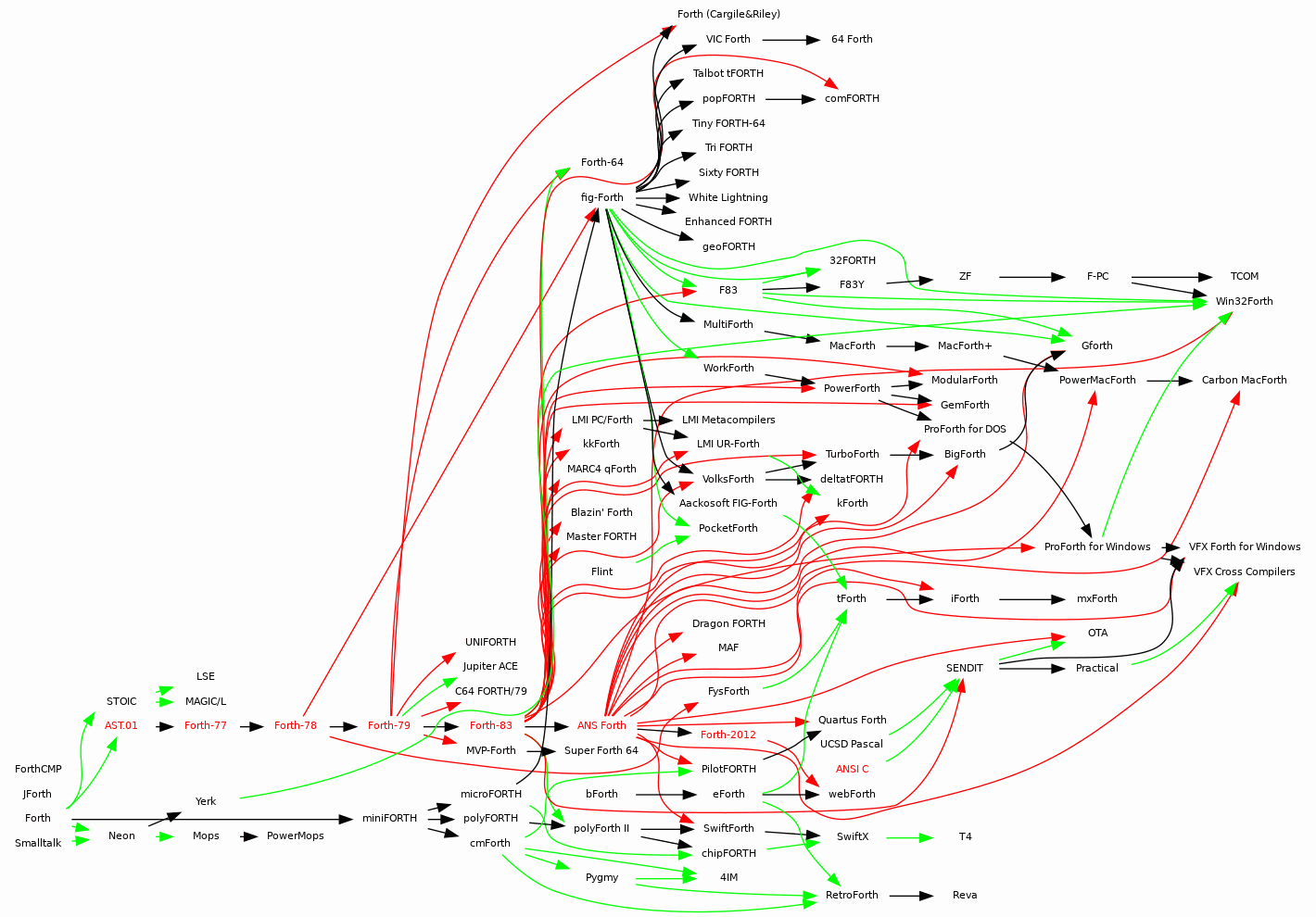
The Forth family tree (chart by Anton Ertl)
This is the family tree of a single programming language, Forth - sixty-odd years of it, time running left to right. Black lines are inheritance of actual code, green lines are borrowed ideas, red lines are agreements to follow a written rule. Look at the far left: the line marked "Forth" doesn't begin anywhere. It enters from off the page. Everything downstream of it is still running on machines that were themselves built by things in this diagram, and the vast majority of the code here has been scrapped.
So where is the bottom? We might be tempted to say something like the 21st of June, 1948, when the first computer program was stored in Manchester (the Manchester Baby!). But the Baby ran a program that June which had been written before it ran, on paper, by hand, by people who'd been doing that for years on machines that weren't stored-program - and the machine it ran on was built from valves and a cathode ray tube designed for radar. Push and it splits again: the radar had a war behind it, the valves had a telephone network, the notation on the paper had Babbage, and Babbage had looms. Every candidate for the origin turns out to be a place where two older things met. The date isn't wrong. It's just an edge, and edges do not resolve into points. It vanishes into your next question for exactly the reason the undefined region cannot be eliminated: there is no vantage point outside the sorting from which to watch the sorting happen. The synchroniser is itself made of gates.
Like the garden, computers require a steward to keep things on track, gently stabilising each side, with minimal input to keep it from spinning out into disorder - we tend to our software similarly. It's all a dance at the edge of chaos to create meaning. Erasing memory in your program releases heat, like the body of a decaying animal, or the weed you pull up and onto the compost pile - it returns to the same stuff. Information is physical; forgetting warms the room - you can read that fact, or you can feel the planet burn.
The instinct to plot nature against technology isn't wrong necessarily - edges are real, but they are transient things in which work is involved to stabilise. The question is not one of determining the ethical case of the edge, it's to ask: what does it cost us to maintain it? We expend energy to hold an edge which creates a suppression that may not need to be there. My feeling is that the better line to draw, if we're doing the drawing, is the specific applications and orientations of technology under capitalism - there are parts that need damping and other more utopian applications in which we can add gain. To my fellow leftists - some applications of AI are actually alright you know - you must choose your edge wisely! A techno utopian future is freed up as a path to us because we're not trying to get back to a previous state. We're choosing an existing reality and deciding where the gain goes. Our machines of abstraction have always worked both with us and against us - and as a matter of fact, of us - so let's not do away with letters, and words, and symbols, and bytes, yet, shall we?
The bootstrapping problem of technology is that of consciousness, and same again to anywhere you try to draw an edge. It is neither moment nor place: historical, with roots, but without foundation. At this limit where meaning making happens, something does physical work to hold it, and when the work stops, so does the line. Every step back just produces a new vantage point to which the semantic boundaries shift. Just a dot, in a continuum. Like a standing wave, which looks like an object but which is actually a relation being continuously performed.
Why does the pigeon cutting silently through a quiet sky, or the pile of leaves carefully assembled by the cool wind, or the poppy proposing through a concrete crack, haunt us? Why does it sometimes feel like they paved paradise and put up a data centre? The world breaks open through the line the pigeon cuts. We see through the split edges of the world, the ridges of history, and through it sometimes we catch a glimpse at something older, something lost, moving through us. What comes through is sometimes awe, sometimes a clarity that feels like knowing. Other times it's despair, and distance, we feel disassociated and detached from the world. So why do we move, so quickly, to put the modern world as the sole cause of that feeling? In which technology, as it stands, is in conflict. My proposal here is that the categoriser's response to the crack is causing us to continuously pay to keep it closed, and that perhaps it's better, less spiritually exhausting, to maintain different edges...
The included text is the introduction to Women Who Run With the Wolves: Myths and Stories of the Wild Woman Archetype by Clarissa Pinkola Estés. The book itself is a mix of Jungian psychology, mythology and folklore, mixed with cultural critique. Regardless of where you stand philosophically on what I've touched on in this letter, I do think, when we're honest with ourselves, we can all feel something wild in us - some history without foundation, something that feels like an echo. But in the quest for an inner wilderness, I fear we sometimes get lost in our origin story. We feel an echo, and expect, if we listen hard enough, to be able to locate a first sound. Allowing the myth of the wolf back amongst us isn't to exhume a body; it's to realise the wolf was never buried at all. She's live expenditure. She's what's happening in you right now, and the reason she seemed absent is that something was paying, continuously, to keep her damped. It's the same bootstrapping problem as hard and software - whatever it's made of, something older echoes by virtue of the very fact that it's here, and the process is simply still running. So the search back to the origin may be futile while the bubbling up of history in our bodies is not, and both of those can be true at once. You can be perfectly relaxed about physics having a t=0 and still have no founding moment in the sense that matters, or matter making sense, because the sense that matters is semantic, and semantic edges don't inherit their location from temporal ones. Perhaps it's even the opposite - their lack of temporal origin is precisely what allows meaning to be made, in that indeterminate gap, fuzzy in both location and time. Seeking an origin doesn't fail because our psychoanalytic tools, or our measurement devices, aren't accurate enough. It fails because it seeks an edge - and edges, on inspection, do not resolve into points.
So why are these moments so fleeting? You see a glimmer of truth break through these words for a moment, but it fades before you get eyes on it. Last summer I sort of saw an imp from the forest. I say 'sort of', because I knew he was there, but every time I looked, the mischievous little fucker ran from the corner of my eye. We grasp it, only to, in the next breath - when we're about to make sense of what we've seen - lose sight of it almost immediately as it disperses back into the ether. This transient nature of experiential truth is, I think, because the categoriser is a discretiser, and it's working continuously to hold values against noise. The glimpses come in the gaps: the massage, the lightning-read, the pigeon, the imp, folklore and story, the moment before the synchroniser resolves. Ridge work isn't reaching past your faculties toward something they can't hold. It's the brief non-completion of the edge-work they're always performing. The wild appears in the undefined region - not because it lives elsewhere and visits, but because that's the only window in which the sorting isn't finished.
The categoriser (intellect, ego, language, logic) is the edge-drawing organ. Asking it to hold "edges are held through expenditure" is asking it to file, as a stable value, the thing that dissolves the operation of holding stable values. It can do that - you can know "no foundation" perfectly well, I do, you may have understood it from this letter, it changes nothing. But to actually have it, the sorting would have to stop, and when the sorting stops that isn't comprehension. It's embodiment. That's the massage. That's ridge work. So the only place the thesis is ever true for you is the one place you can't think it. This letter can't deliver its own content. The body is also the only place the expenditure is legible, because it's where the accounting is done. A synchroniser can't resolve the undefined region - it can only be given time. But as we've seen, the synchroniser is itself made of gates, each with its own undefined region. The device for handling indeterminacy is built from the thing it's handling, all the way down. I am, my friend, constrained here by words, abstraction, language and logic - "using words that summon up the opening of a passageway" (Estés again).
The text is about magic and folklore, divination and story. Tools which work through their refusal to engage on the terms of the categoriser. They open a portal to meaning making flowing both ways - they produce a gap and we're moved to fill it. In that refusal, they open up space so that the sorting has nowhere to land and the meaning must be found elsewhere. It's true, friends, the world is magical and magic is real. Divination, story, ourselves, we're in the same ontological category as a logic gate.
The rarity of those precious gap-moments can sometimes make everything stable between them feel hollow - like we're coasting through life, only sometimes catching meaning but never able to quite sit in it fully. But this is the trap of the lost foundation, and the distinction matters both personally and politically. Personally, for the depressive, the anxious, the addict; for anyone who has gone looking for the missing piece and found the looking becoming the illness. Politically, for our movements. If the question is one of repression and recovery, we're left with nostalgia and a return-to-nature, and no one to hold responsible, because nothing took the foundation - it was never there. But if the hollowness is suppression, the answer becomes one of locating the energy: what is doing the damping, what does it cost, who is collecting, and what tools do we have for adding gain? Text is a tool, and I'm handing you one here. Estés doesn't need to be true - she needs to be effective. The archetype of the wild woman is not a finding; the folklore helps us reach towards the echo and into history, and we can do that without hunting for foundations. I still don't believe in an essential gendered soul - but a description doesn't have to locate a truth for the instrument to be superb. Particularly when it's a delivery mechanism for something with no other route - the summoning of a passageway through story. It's my hope that you'll find something in this mythopoetic instrument and perhaps with it, venture into your own experiments in ridge work.
I have my doubts that the text will land the same way for you, friend. We're never much in control of when and what will strike us. But I know, in my more coherent moments of a self that projects outwards, that I'd love to read, and see, and listen to things that have moved you in ways that shift your centre elsewhere. So perhaps you'll enjoy mine and forgive me this massive indulgence.
In the warmest of my daydreams, I imagine opening the post each week to find postcards from friends. Some of us trying out our writing, others perhaps sharing works of art without comment. Some small and sent off haphazardly, perhaps others slower and intentional. To have updates reach us through the slower networks of the postal routes has a grounding charm to it; in times like these, we can all permit ourselves a little nostalgia (despite the cautionary tale above not to dwell in it). So perhaps I can encourage you to continue this new theme of sending letters to friends.
To make that easier, I've built a small website: slowernetworks.com, which you can join via your invite code. It works like this: if you'd like to receive things in the post from other people, make a profile and add your postal address. When you have something to send - a letter, a zine, a drawing, whatever you've made - you can request the address list from me via that site. You can find more details on the website. Right now it's a very small network of my friends, but I'd love it to grow into a community (although always staying small) through friends of friends, and outwards from there.
With lots of love,
Bernie
P.S. All this because really I wanted a reason to make a business card.